
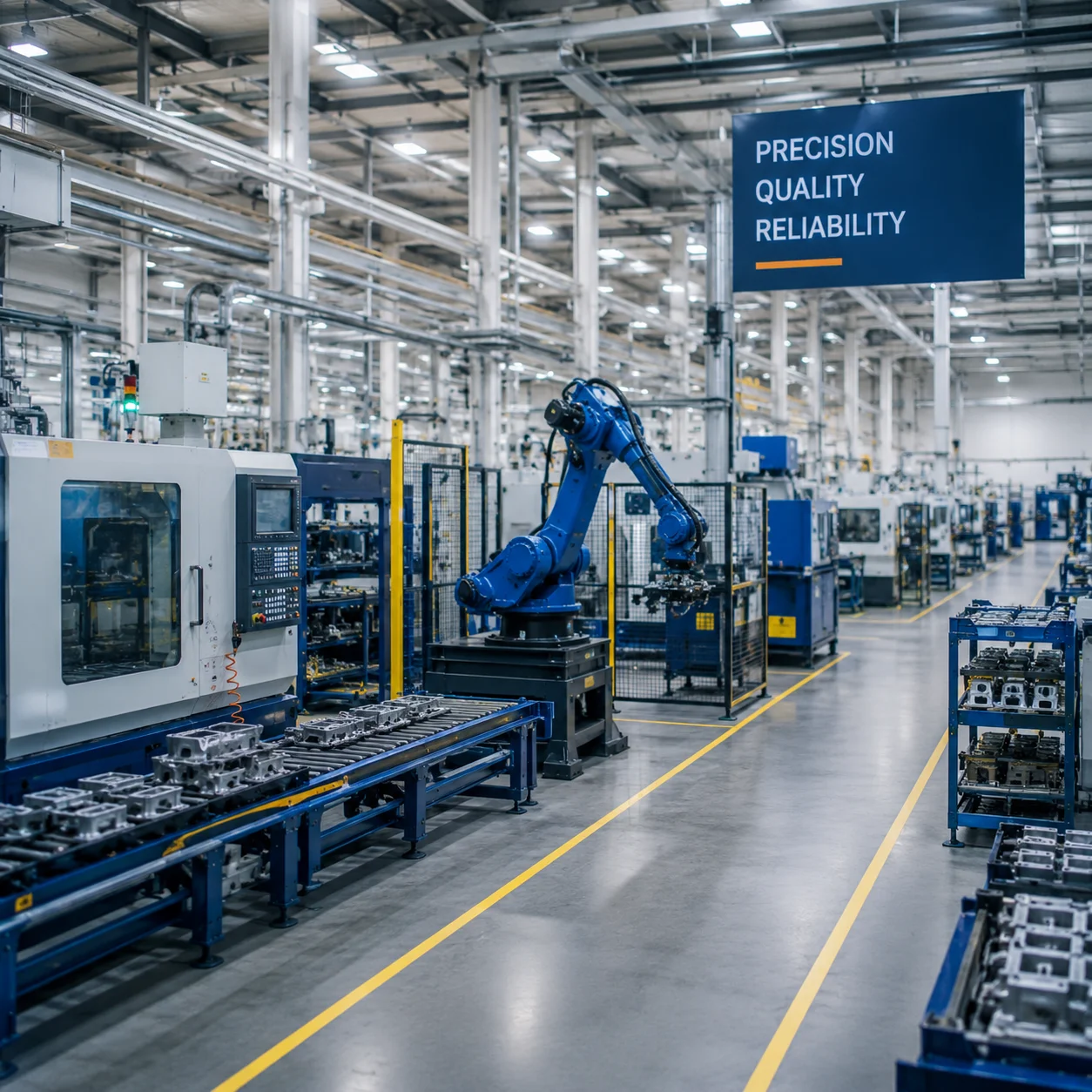

If you sell HVAC equipment — or want to — at some point the question arrives: should we keep reselling someone else’s brand, or put our own name on the box? Building your own air-conditioner line used to mean owning a factory. It doesn’t anymore. Today over 30 brands ship product off Synoglim’s production line, in more than 100 countries, without owning a single screwdriver.
This guide walks through how that works: what OEM and ODM actually mean, what you can change, what you can’t, realistic order volumes and timelines, and the step-by-step of a partnership from first email to delivered container.
OEM or ODM — which one do you actually need?
The terms get used interchangeably, but they describe two different relationships.
| OEM (Original Equipment Manufacturer) | ODM (Original Design Manufacturer) | |
|---|---|---|
| What you bring | Your brand, your spec, sometimes your design | Your brand and your target market |
| What we bring | Manufacturing to your specification | The design, the engineering, and the manufacturing |
| Best when | You already know exactly what you want built | You want a proven platform you can put your name on quickly |
| Typical lead time | Slightly longer (tooling, sample rounds) | Faster to first shipment |
| Example | “Build this split AC to our drawings, our refrigerant, our energy label.” | “Give us your best-selling 12,000 BTU inverter split — our logo, our packaging, EU plug.” |
Most new brands start with ODM (a known-good platform, lower risk, faster to market) and graduate to OEM as their volumes and product opinions grow. There’s no wrong door — the same factory, QC line, and component supply chain sit behind both.
What you can customize
Six dimensions, in roughly the order brands care about them:
- Logo & color. Your logo on the chassis, the remote, the carton, and the user manual. Custom panel colors are available at MOQ 1,000+ — a white-and-grey unit can become your white-and-grey unit.
- Packaging. Custom carton design, language combinations for your markets, retail-ready packaging, gift sets, and barcode/SKU formatting.
- Voltage & plug. 110V / 220V / 380V configurations; UK, EU, US, and AU plug standards; region-specific power cords. This is the single most common spec change — never assume a unit “just works” in your grid.
- Refrigerant. R32, R410A, or R290 depending on local regulation. EU F-Gas–compliant variants are available where you need them.
- Smart features. Tuya / Smart Life / Alexa / Google Home integration out of the box, or custom firmware so the units pair with your branded app.
- Energy rating. EER tuning to hit the energy label you’re selling against — A, A+, A++, A+++ — with EU and GCC label formats supported.
What you generally can’t change at small volume: the core compressor and refrigeration architecture, the certification scope of a given platform, or anything that would require re-tooling below the MOQ. The honest version of customization is “a lot, within the envelope of a proven platform” — and that envelope is wide.
MOQs and lead times — the real numbers
These are starting points, not hard walls; tiers move with volume and customization depth.
| Product line | Minimum order | Lead time | Customization tier |
|---|---|---|---|
| Split AC (residential) | 500 units | 30–45 days | Logo, packaging, voltage |
| Window AC | 300 units | 30 days | Logo, packaging |
| Portable AC | 200 units | 30 days | Logo, packaging, plug |
| Cassette / Duct AC | 100 units | 45–60 days | Logo, packaging, voltage, refrigerant |
| VRF systems | 20 systems | 60–75 days | Full ODM available |
| Solar hybrid AC | 200 units | 45 days | Logo, packaging, controller |
A few things worth knowing:
- Lead time starts after sample sign-off, not after the first inquiry. Budget an extra 2–4 weeks up front for spec, quote, and sample rounds on a first order.
- Repeat orders are faster — the tooling and artwork already exist.
- Mixed containers are possible. You don’t have to hit 500 units of one SKU; you can blend lines to fill a 20’/40′ container, within each line’s own minimum.
Shipping, spares, and after-sales
Manufacturing is the easy half. The orders that go smoothly are the ones where logistics were agreed on day one:
- Incoterms: FOB, CIF, or DDP — whichever matches how your team likes to handle freight and customs.
- Spare parts: stocked in your warehouse as part of the order, so a field failure doesn’t become a six-week ocean wait.
- Installation training: local installer training so the units go in correctly and your warranty exposure stays low.
Quality control you can verify
Every unit gets 100% functional testing before it leaves the line. On top of that, you can book third-party inspection (SGS, BV, Intertek, or your own agent) before the container is sealed — Synoglim’s job is to make that inspection boring. Component sourcing is locked at PO time, so the unit that passes the sample round is the unit that ships.
How a Synoglim OEM/ODM project runs
Five steps, inquiry to delivery:
- Inquiry & spec. You share volume, target market, and customization requirements. We come back with a quote within 24 hours.
- Sample & approve. You receive a pre-production sample carrying your branding, for testing and approval before mass production starts.
- Tooling & PO. Sign off on artwork and tooling, place the purchase order, and component sourcing begins.
- Production & QC. A 30–45 day production window (longer for cassette/duct and VRF), 100% functional testing, optional third-party inspection.
- Ship & support. FOB / CIF / DDP shipping, spare parts pre-positioned in your warehouse, local installation training.
Common questions
How long until our first container ships? For an ODM platform with light customization (logo + packaging + voltage): roughly 6–9 weeks from confirmed PO, plus 2–4 weeks of spec and sampling before that. OEM with new tooling adds time on the front end.
Can we start small and scale? Yes — that’s the normal path. Start near the MOQ on one or two SKUs, prove the market, then widen the range and raise volumes. Customization tiers open up as order sizes grow.
Which products can carry our brand? Split, window, portable, cassette/duct, VRF, and solar hybrid units — essentially the full Synoglim catalog. Heat pumps and floor-standing units can be discussed case by case.
What about certifications? Platforms carry the relevant market certifications (CE, energy labels, refrigerant compliance); the exact scope depends on the product line and your destination markets. Confirm certification coverage in the spec stage — before tooling, not after.
Start the conversation
If you have a target market, a volume, and even a rough spec, that’s enough to get a real quote — including a sample timeline and a shipping estimate — back within 24 hours.
→ Explore the OEM / ODM program or contact our sales team to get started.
Synoglim Environmental Energy Technology Co., Ltd. manufactures inverter and non-inverter air-conditioning solutions — split, window, portable, cassette, duct, VRF, solar hybrid, and heat pumps — for brands and distributors in 100+ countries.